
Guide
Visual novel: what it is, its kinds and how it differs from an AI story
A visual novel is a story told on a screen through text, character art, backgrounds and music, moved forward one tap at a time. This guide lists the main kinds, from stories with no choices at all to mysteries and dating sims, and sets the form beside its neighbours.
Play a story like this
Ready stories from the library. The first scene opens right away, no account needed.
- Fantasy romance The Ash GateThe north road burned, the gate was opened from inside, and the warden has not slept in nine nights.
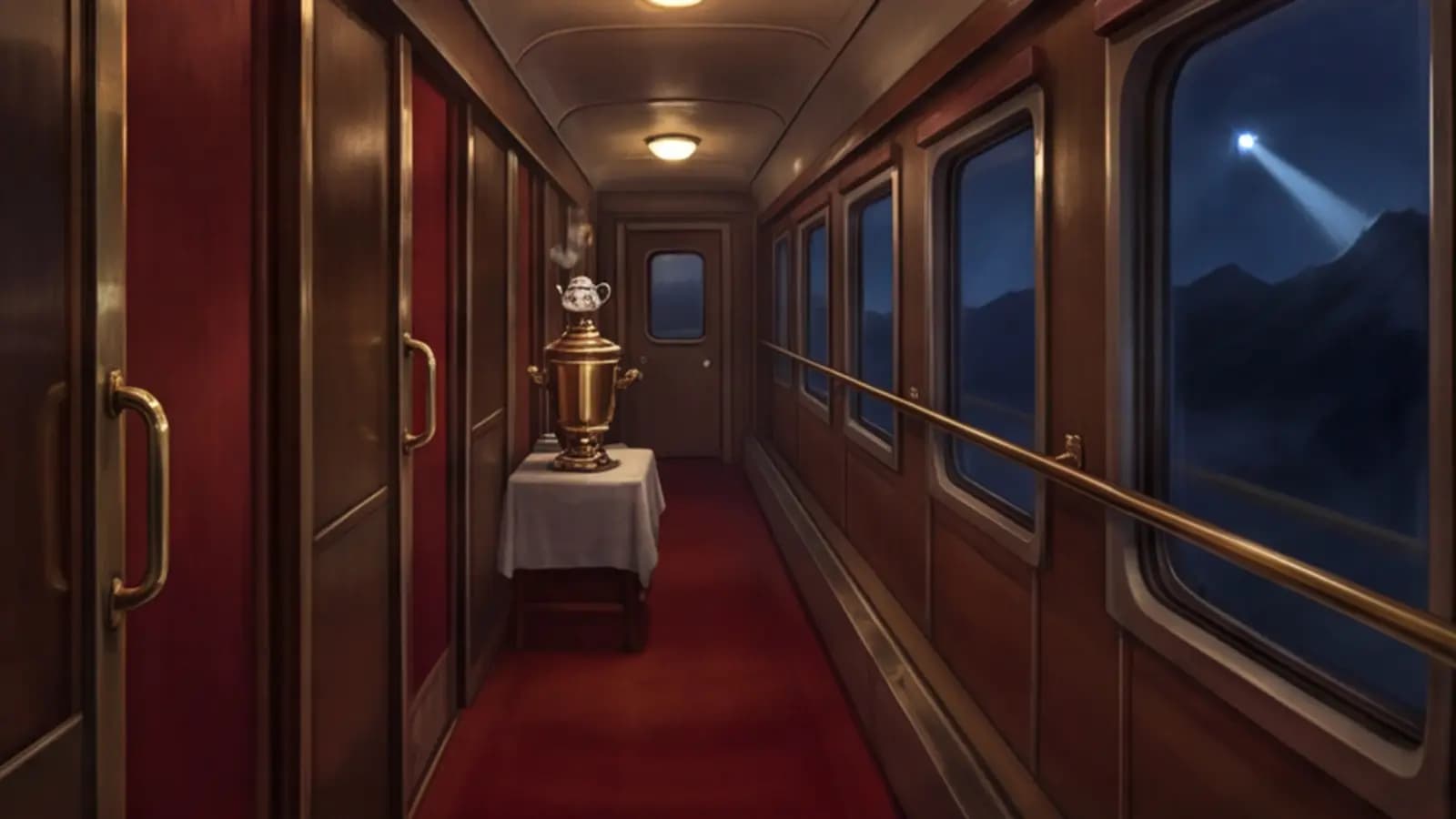
- Thriller The Night Train to BakuAn hour out of Tbilisi, a pipeline auditor lies dead in compartment four.
- Space opera Icarus CupA solar-sail race dives past the Sun once every eleven years.

Kinds of visual novel
Kinetic novel
A visual novel with no choices. The story runs along one line from the first screen to the last, and the reader only turns the pages. The name comes from the label of a Japanese publisher and spread to every work of this kind.
Play: The Ash GatePlay this storyBranching visual novel
The story forks at choices and leads to several endings. Some forks act at once; others only add to a hidden tally that decides the ending much later. Seeing everything takes several readings.
Play: The Night Train to BakuPlay this storyVisual novel with stats
Reading is mixed with numbers to manage: skills to train, days to plan, money to earn. The story checks those numbers at its turning points, and a scene opens only to a heroine who is ready for it.
Play: Icarus CupPlay this storyMystery visual novel
The reader investigates: questions witnesses, collects evidence and has to draw the conclusion personally. A wrong accusation ends the story badly. This line grew out of Japanese adventure games about solving a murder.
Play: The Sixty-Hour VaultPlay this storyDating sim
A close relative built around courtship. It looks like a visual novel on the screen, and adds a layer of scores and time management underneath. Affection is won by the right mix of both.
Play: The Night Train to BakuPlay this storyOtome game
A romance written for women players, with a heroine and several male love interests. Each love interest has a branch of the story, called a route, with endings of its own.
Play: Sugar Moon over AsakusaPlay this story
What a visual novel is made of
The text box
Narration and dialogue appear in a box, a few lines at a time. A tap or a click brings the next lines. The pace belongs to the reader, which is the main difference from a film.
Play: The Ash GatePlay this storySprites and backgrounds
Characters are shown as still drawings placed over a painted background. A change of expression or pose stands for a whole gesture, and the reader’s imagination supplies the movement.
Play: The Night Train to BakuPlay this storyChoices
Where the story forks, a short menu appears: what to say, where to go. In many works these moments are rare, and a long stretch of pure reading lies between them.
Play: Icarus CupPlay this storyRoutes and endings
A branching work divides into routes, long branches with endings of their own. A route often belongs to one character. Readers usually sort the endings into good and bad ones.
Play: The Ash GatePlay this story
Neighbours of the visual novel
Interactive fiction
The older, text-only relative. In its classic form, the text adventure, the player types commands and the program describes the result. A visual novel offers a menu instead and adds pictures and sound.
Play: The Ville de BrestPlay this storyGamebook
A printed book read out of order. Each passage ends with options and the numbers of the passages to turn to. It is a branching story with no screen.
Play: Icarus CupPlay this storyAI story
No branch is written in advance. An AI narrator writes each scene when it is reached. The player may type a move of one’s own instead of picking from the menu.
Play: The Ash GatePlay this story
What a visual novel is
A visual novel presents a story through text boxes over still character art and backgrounds, with music and sound. The reader advances it by clicking or tapping.
The form comes from Japan, where such works are often called novel games and counted as a kind of adventure game. The English name appeared in the 1990s.
It is an old argument if a visual novel is a game at all. Some have no choices, and in many the player’s part is small. Readers come for the story.
How the kinds differ
The kinds differ in how much the reader does. A kinetic novel asks for nothing but reading. A branching one asks for decisions, and one with stats asks for planning.
A mystery asks for thought: the story will not go on until the reader has understood something. That makes it the kind closest to a puzzle game.
A visual novel and an AI story
A visual novel is finished before anyone reads it. Every branch was written and drawn by its authors, so the number of branches is limited.
On PlayAIStories the scene is written when it is reached, so a branch does not need to exist in advance. Each scene ends with several choices, and there is always room to write a move of one’s own instead.
The other difference is the form. The story is prose, with pictures on the paid plans, and risky moves are settled by a die.