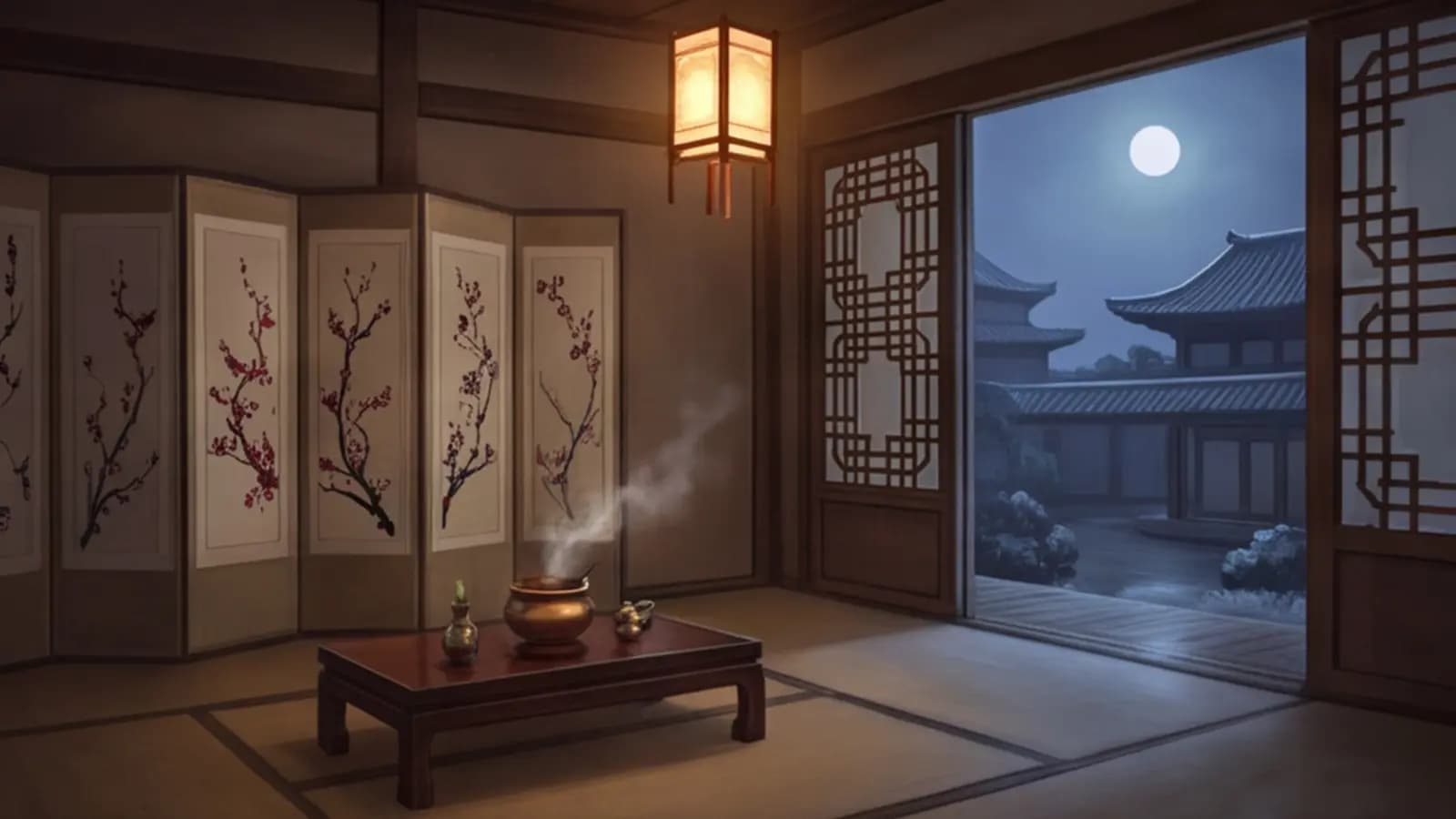
First scene
The Silk Cord
Okhwa
Physician… the medicine… listens…
What will the hero do?
The scene goes on from the choice made.

The Joseon palace at Hanyang in 1762 is a city of tiled roofs, courtyards and gates, ruled by a Confucian king through ministers, eunuchs and court ladies. The physicians of the Royal Dispensary are educated but not noble, and they may take a royal woman’s pulse only through a silk cord tied to her wrist. A falsified record is treason. A servant who speaks of the royal family’s private life can be beaten to death.
The hero is the newest physician of the dispensary, of low birth and high skill. At the third watch the hero is called to the women’s quarters, where a young lady of the crown prince’s household lies behind a painted screen. Through the red cord the pulse speaks plainly: a slow poison that no physician dares to name.
The head court lady Malsun sits beside the screen, watching every movement of the hero’s fingers, and orders the record to say indigestion. The chief physician Iksu, arriving from his bed with his robe askew, agrees. The palace is a powder keg. The king and the crown prince have quarrelled for years, factions are gathering proof of the prince’s madness, and the patient knows something about him.
If she dies, what she knows dies with her. If she speaks, the palace may explode. The choices change the plot, and every diagnosis, lie and visit to the storerooms comes down to a roll of the dice.
First scene
Okhwa
Physician… the medicine… listens…
What will the hero do?
The scene goes on from the choice made.

Historical
Tenochtitlan, 1507.

Historical
The Taklamakan, 755.

Historical
Shanghai, 1927.

Historical
Iceland, the year 1000.

Historical
Rome, 52 BC.

Historical
London, May 1866.

Historical
Kaifeng, 1124.

Historical
Timbuktu, 1352.

Historical
Constantinople, 1042.

Historical
Agra, 1657.

Historical
Istanbul, 1633.

Historical
Edo, 1702.